Automate ISO 26262 Compliance with GPT-4 for Automotive Safety Analysis


Last edited 223 days ago
:car: Business Value Proposition
Accelerates ISO 26262 compliance for automotive/industrial systems by automating safety analysis while maintaining rigorous audit standards.
:gear: How It Works
graph TD
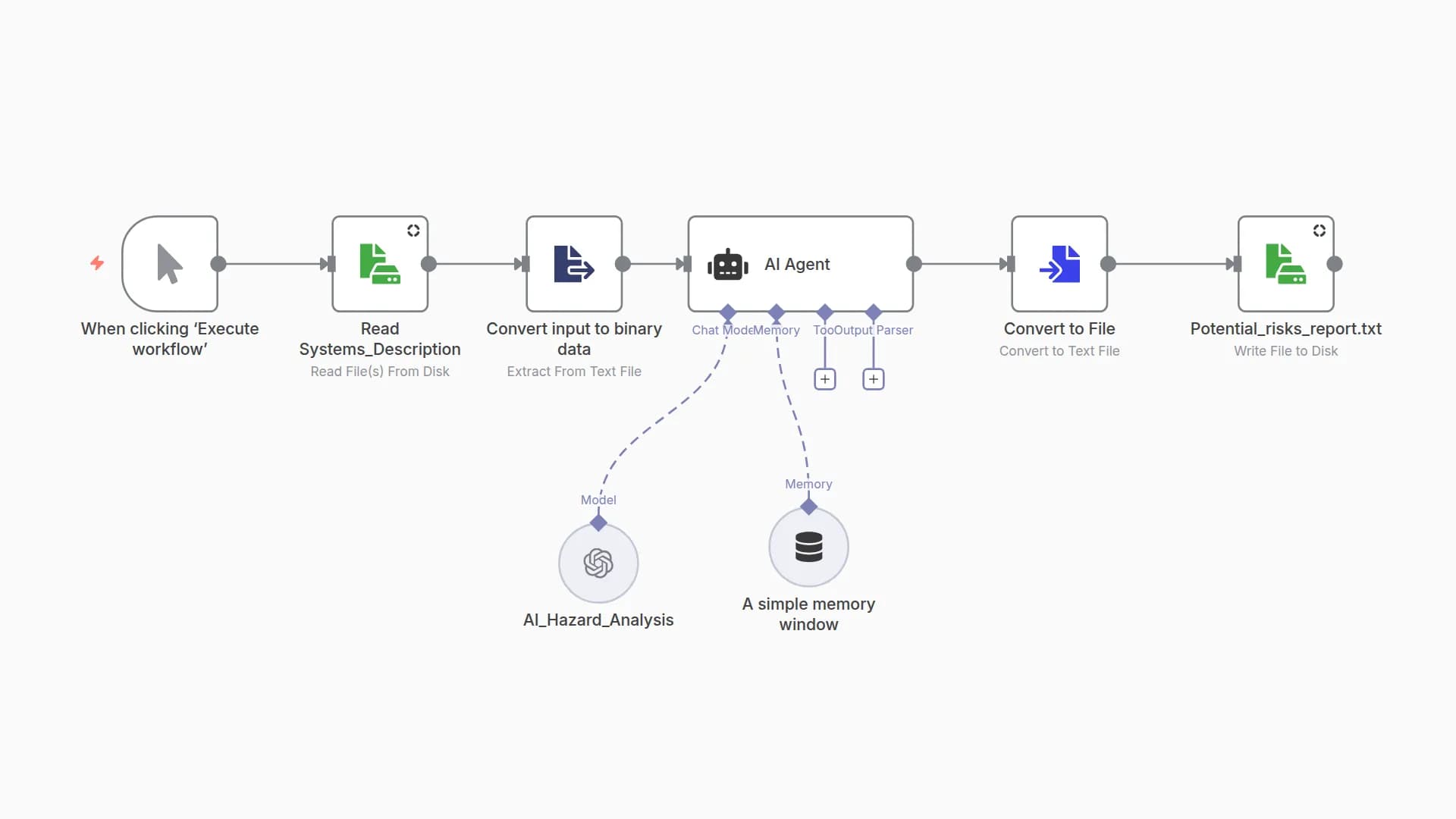
    A[Engineer uploads<br>system description] --> B(LLM identifies hazards)
    B --> C(LLM scores risks per ISO 26262)
    C --> D(Generates mitigation strategies)
    D --> E(Produces audit-ready reports)
:chart_with_upwards_trend: Key Benefits
-
Time
- 50-70% faster than manual HAZOP/FMEA sessions
- Instant report generation vs. weeks of documentation
-
Risk Mitigation
- Pre-validated templates reduce human error
- Auto-generated traceability simplifies audits
:warning: Governance Controls
- Human-in-the-loop: All LLM outputs require engineer sign-off
- Version tracking: Full history of modifications
- Audit mode: Export all decision rationales
:computer: Technical Requirements
- Runs on existing n8n instances
- Docker deployment (<1hr setup)
- Integrates with JAMA/DOORS (optional)
:wrench: Setup and Usage
Prerequisites
- Docker (Install Guide)
- Docker Compose (Install Guide)
- n8n instance (Free Self-Hosted or Cloud - Paid)
- OpenAI API key (Get Key)
Enterprise-ready deployment: When supported by IT infrastructure teams, this solution transforms into a scalable AI safety assistant, providing real-time HARA guidance akin to engineering Co-pilot tools.
:arrow_down: Installation and :play_or_pause_button: Running the Workflow
For installation procedures and usage of workflow, refer the repository
:warning: Validation & Limitations
AI-Assisted Analysis Considerations
Advantage
Mitigation Strategy
Implementation Example
Rapid hazard identification
Human validation layer
Manual review nodes in workflow
Consistent S/E/C scoring
Rule-based validation
ASIL-D → Redundancy check
Edge case coverage
Cross-reference with historical data
Integration with incident databases
Critical Validation Steps
-
AI Output Review node in n8n
Example: (by code){ "type": "function", "parameters": { "functionCode": "if ($input.item.json.ASIL === 'D' && !$input.item.json.redundancy) throw new Error('ASIL D requires redundancy');" } } -
Version Control
- Prompt versions tied to ISO standard editions (e.g., ISO26262:2018-v1.2)
- Git-tracked changes to ai_models/training_data/
- Audit trails
- Providing a log structure for audit trails
# Log structure
/logs/
└── YYYY-MM-DD/
  ├── hazards_approved.log
  └── hazards_rejected.log
You may also like
New to n8n?
Need help building new n8n workflows? Process automation for you or your company will save you time and money, and it's completely free!