Generate Marketing Reports from Google Sheets with GPT-4 Insights and PDF.co


Categories
Created by
rbRobert BreenLast edited 206 days ago
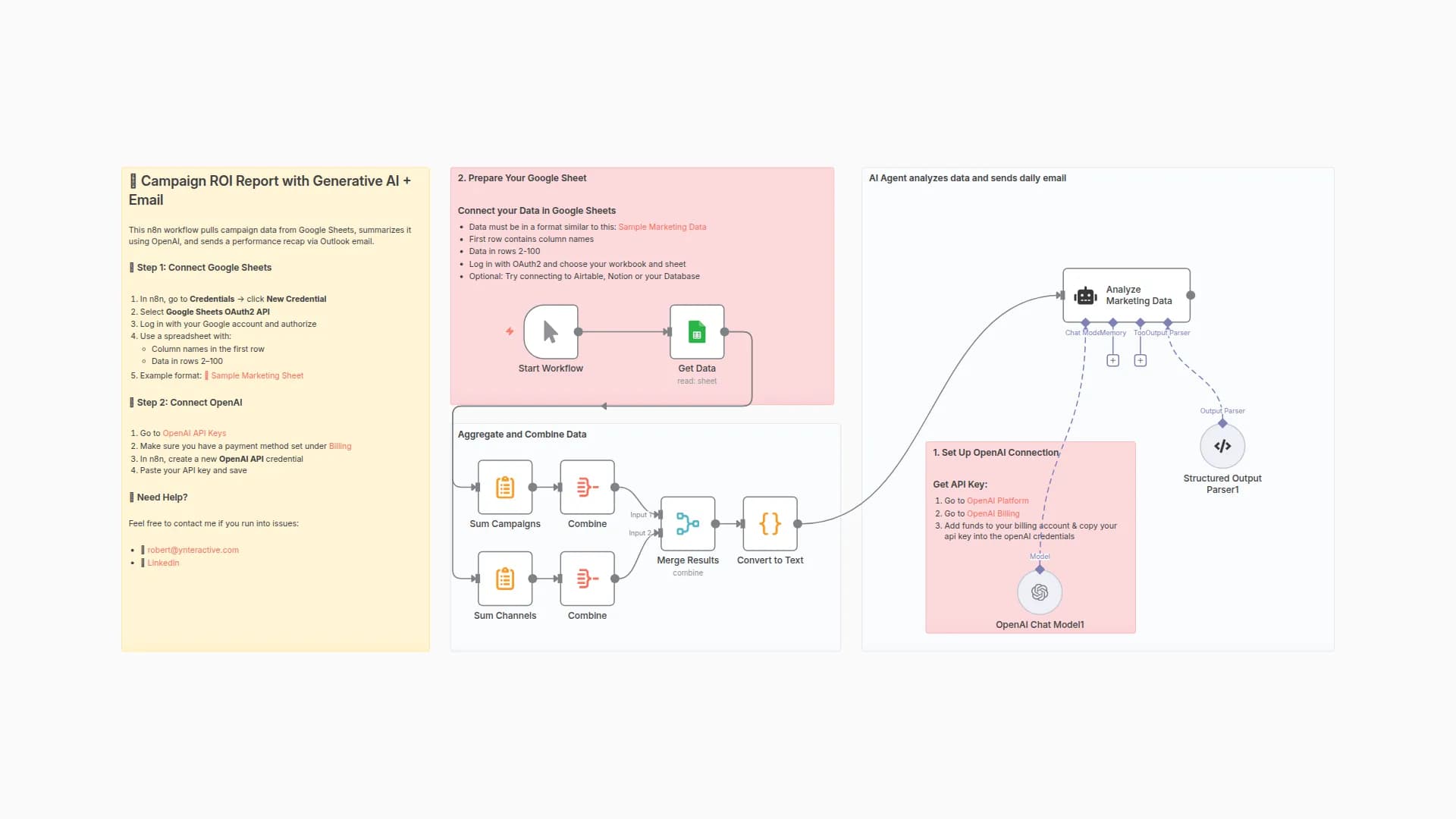
This workflow pulls marketing data from Google Sheets, aggregates spend by channel, generates an AI-written summary, and outputs a formatted PDF report using a custom HTML template on PDF.co.
⚙️ Setup Instructions
1️⃣ Prepare Your Google Sheet
- Copy this template into your Google Drive: Sample Marketing Data
- Add or update your marketing spend data in rows 2–100.
Connect Google Sheets in n8n
- Go to n8n → Credentials → New → Google Sheets (OAuth2)
- Log in with your Google account and grant access
- Select the Spreadsheet ID and Worksheet in the workflow
2️⃣ Set Up PDF.co for PDF Reports
- Create a free account at PDF.co
- In PDF.co Dashboard → HTML to PDF Templates, create a new Mustache template
- Paste the HTML provided at the bottom of this description
- Save, and note your Template ID
- In n8n → Credentials → New → PDF.co API, paste your API Key and save
- In the workflow, select your PDF.co credential in the
Create PDFnode - Replace the
templateIdwith your Template ID
🧠 How It Works
- Google Sheets Node: Pulls marketing spend data
- Summarize Nodes: Aggregate total spend and spend per channel
- OpenAI Node: Writes a daily summary of marketing performance
- Code Node: Converts aggregated data into the correct shape for the PDF template
- PDF.co Node: Generates a final, formatted PDF report
📬 Contact
Need help customizing this (e.g., filtering by campaign, sending reports by email, or formatting your PDF)?
📄 HTML Template (for PDF.co)
Paste this into a new HTML Template on PDF.co and reference its Template ID in your workflow.
<!DOCTYPE html>
<html>
<head>
  <meta charset="utf-8" />
  <title>Invoice {{invoiceNumber}}</title>
  <style>
    body { font-family: Arial, Helvetica, sans-serif; margin: 36px; color: #222; }
    .header { display: flex; justify-content: space-between; align-items: center; }
    .brand { max-height: 56px; }
    h1 { margin: 12px 0 4px; font-size: 22px; }
    .meta { font-size: 12px; color: #555; }
    .two-col { display: flex; gap: 24px; margin-top: 16px; }
    .box { flex: 1; border: 1px solid #ddd; padding: 12px; border-radius: 6px; }
    .label { font-size: 11px; color: #666; text-transform: uppercase; letter-spacing: .02em; }
    table { width: 100%; border-collapse: collapse; margin-top: 16px; }
    th, td { border-bottom: 1px solid #eee; padding: 10px 8px; font-size: 13px; }
    th { background: #fafafa; text-align: left; }
    tfoot td { border-top: 2px solid #ddd; font-size: 13px; }
    .right { text-align: right; }
    .totals td { padding: 6px 8px; }
    .grand { font-weight: 700; font-size: 14px; }
    .notes { margin-top: 18px; font-size: 12px; color: #444; }
  </style>
</head>
<body>
  <div>
    <div>
      <h1>Invoice {{invoiceNumber}}</h1>
      <div>Date: {{invoiceDate}}   |   Due: {{dueDate}}</div>
    </div>
    {{#company.logoUrl}}
    <img src alt="Logo" />
    {{/company.logoUrl}}
  </div>

  <div>
    <div>
      <div>From</div>
      <div><strong>{{company.name}}</strong></div>
      <div>{{company.address}}</div>
      <div>{{company.phone}}</div>
      <div>{{company.email}}</div>
    </div>
    <div>
      <div>Bill To</div>
      <div><strong>{{billTo.name}}</strong></div>
      <div>{{billTo.address}}</div>
      <div>{{billTo.email}}</div>
    </div>
  </div>

  <table>
    <thead>
      <tr>
        <th>#</th>
        <th>Description</th>
        <th>Qty</th>
        <th>Unit Price</th>
        <th>Line Total</th>
      </tr>
    </thead>
    <tbody>
      {{#items}}
      <tr>
        <td>{{line}}</td>
        <td>{{description}}</td>
        <td>{{qty}}</td>
        <td>{{unitPriceFmt}}</td>
        <td>{{lineTotalFmt}}</td>
      </tr>
      {{/items}}
    </tbody>
    <tfoot>
      <tr>
        <td colspan="4">Subtotal</td>
        <td>{{subTotalFmt}}</td>
      </tr>
      <tr>
        <td colspan="4">Tax ({{taxRatePct}})</td>
        <td>{{taxAmountFmt}}</td>
      </tr>
      <tr>
        <td colspan="4">Discount</td>
        <td>-{{discountFmt}}</td>
      </tr>
      <tr>
        <td colspan="4">Total</td>
        <td>{{totalFmt}}</td>
      </tr>
    </tfoot>
  </table>

  <div>
    <strong>Notes:</strong> {{notes}}<br />
    <strong>Terms:</strong> {{terms}}
  </div>
</body>
</html>
You may also like
New to n8n?
Need help building new n8n workflows? Process automation for you or your company will save you time and money, and it's completely free!